
This article contains everything you need to know about Arkadium's Hurdle Game.
Use the list below to navigate specific topics about Hurdle.

How to play
General rules. Each Hurdle puzzle contains a secret five-letter word you'll need to solve every day. You have six guesses to try to get it right. After each guess, the tiles' colors will indicate how close your guess was to the word:
- If the tile turns green, it's the correct letter in the right spot.
- If the tile turns yellow, the letter is in the word but not in the right spot.
- If the tile turns grey, the letter is not found in the word.
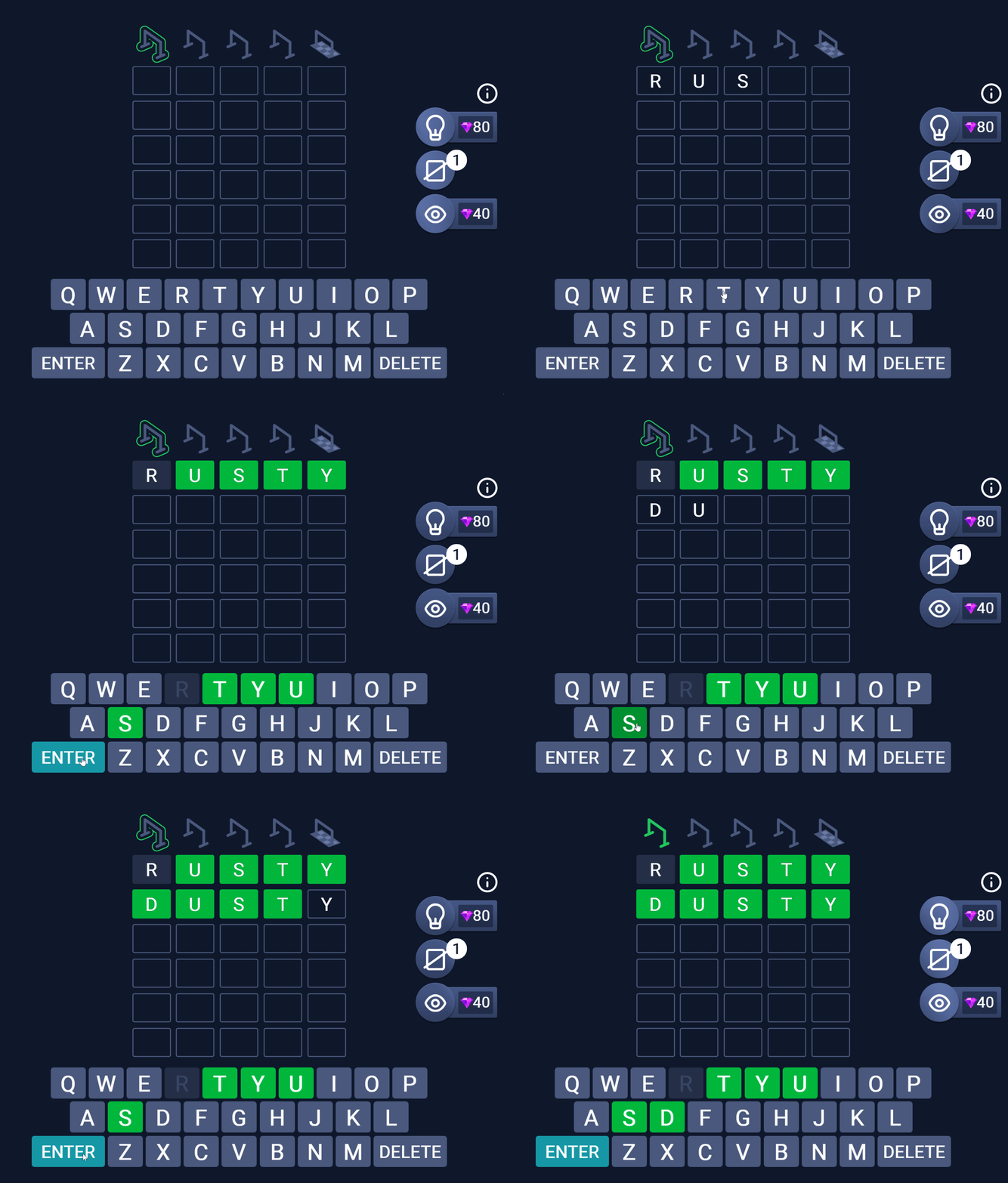
The 5th and final Hurdle puzzle will be prefilled with the answers from the previous 4 Hurdles.
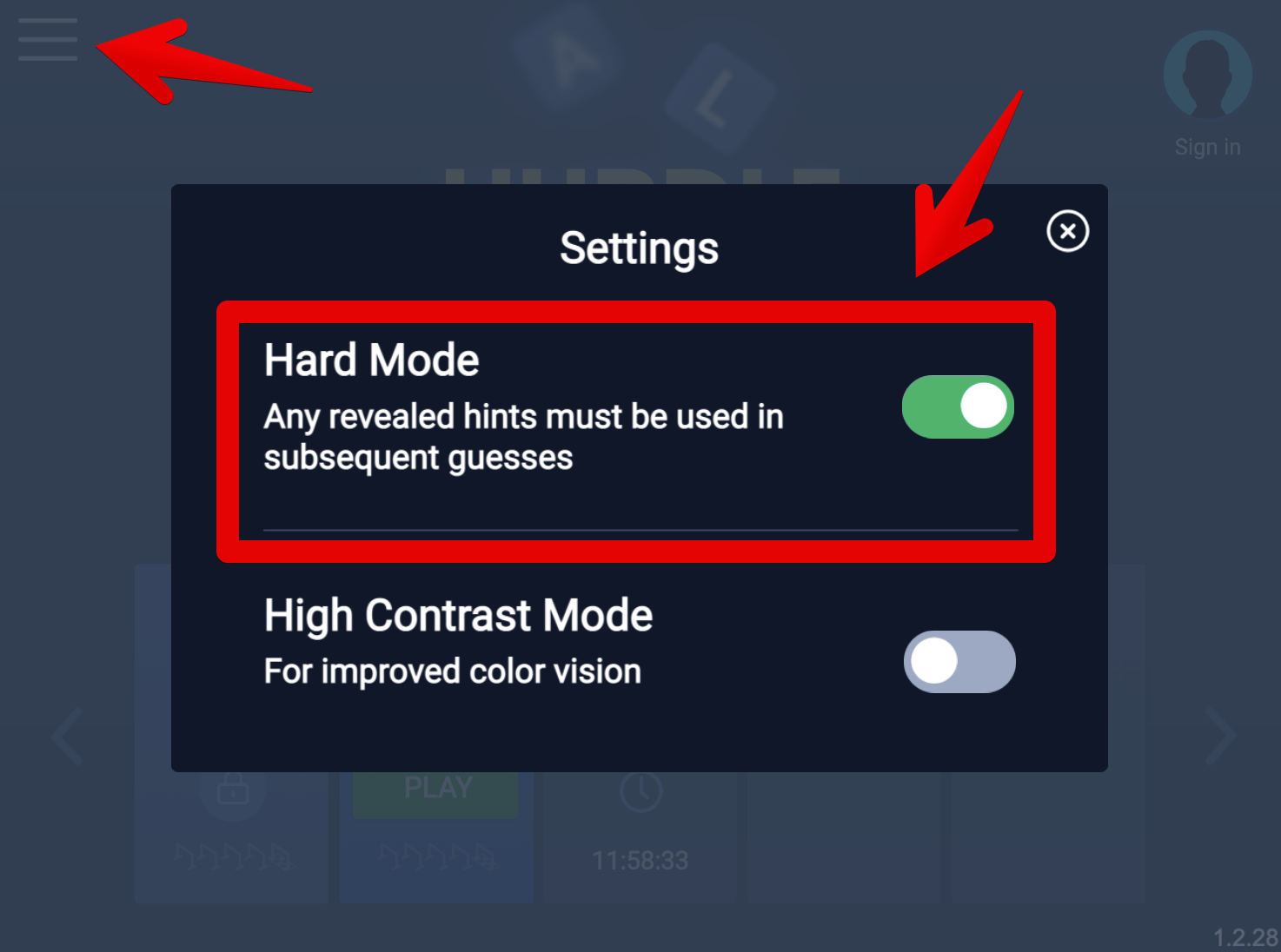
NOTE: you only have 2 chances to solve the final HurdleHard Mode. To enable hard mode, please, click on the "hamburger" menu in the top left corner, click on Settings and enable the Hard Mode dongle.
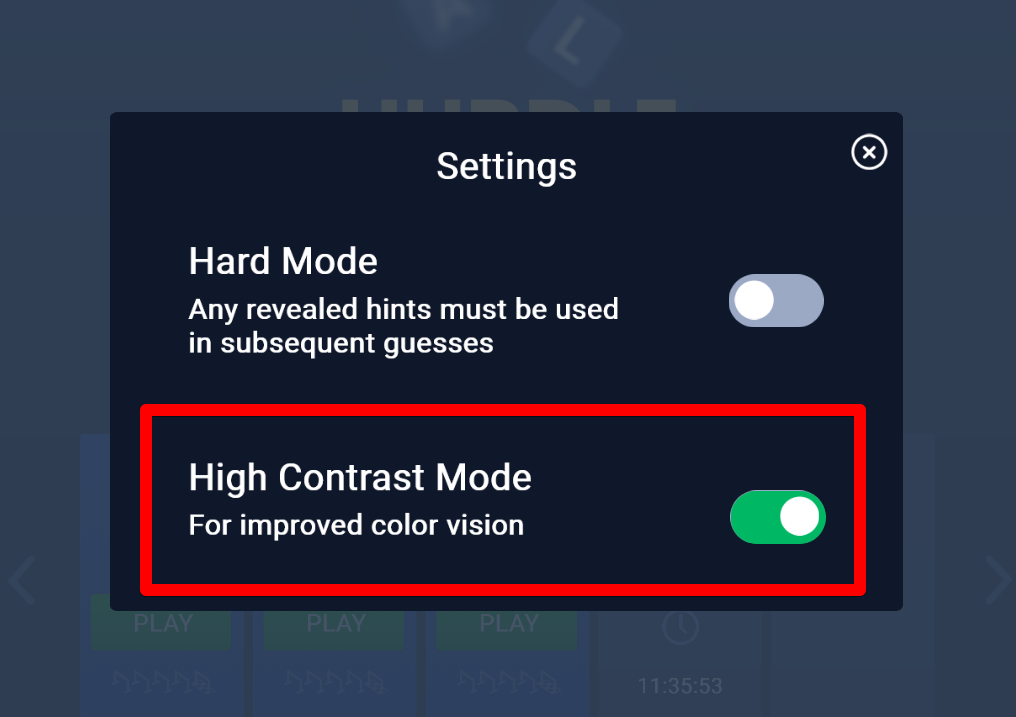
High Contrast Mode. To enable high contrast mode, please, click on the "hamburger" menu in the top left corner, click on Settings and enable the High Contrast Mode dongle. This mode will allow you to view the game in a high contrast should you require.
Recap function. You can use the Recap function at the game end to check your answers.

Secret word. If you didn't guess a secret word, you can see it at the top of the game over screen.

Tips
1. Make Your First Guess Count
Start with a five-letter word containing five different letters and a good mix of common vowels and consonants. Words such as CRANE, SLATE, TRACE, RAISE, or STARE can reveal more information than vowel-heavy or duplicate-letter openings. The goal of the first guess is to quickly establish which letters are worth pursuing.
2. Turn Every Tile Into Information
Treat the color feedback as a set of rules, not suggestions. Green letters stay in their positions, yellow letters must be moved, and gray letters should generally be eliminated. Keep checking the on-screen keyboard as you work, and don't waste guesses repeating letters or positions that have already been ruled out.
3. Build the Word, Don't Just Chase Letters
Once several letters are confirmed, stop prioritizing unexplored letters and start looking for a plausible word pattern. Consider common beginnings, endings, vowel positions, and letter combinations rather than randomly rearranging what you know. Don't assume the answer must be singular or follow another grammatical pattern—let the available positions and feedback determine the candidates.
4. Think Twice About Duplicate Letters
A solution can contain the same letter more than once, so don't automatically discard a word because a known letter appears twice. Pay particular attention when your guess contains duplicate copies: if one receives green or yellow feedback while another is gray, the gray tile can mean there isn't another copy of that letter in the answer.
5. Know When to Solve and When to Test
If only a few candidates remain, an elimination guess can be worthwhile when it tests several competing possibilities at once. However, don't sacrifice a likely solution simply to gather more information—especially with only one or two guesses remaining. Hurdle rewards efficient solving, so once the answer is sufficiently constrained, go for the solution rather than continuing to explore.
6. Save Your Best Analysis for the Final Hurdle
The final Hurdle gives you the four previous answers as starting rows but only two additional attempts, making careful analysis especially important. Combine all the information from those rows, including greens, yellows, eliminated letters, and duplicate-letter possibilities, before entering your first guess. If you're stuck, Hurdle's Clue, Remove, and Reveal Gems can reduce uncertainty, while archived puzzles and Recap provide useful practice for recognizing patterns and avoiding wasted guesses.
Dictionary
Similarly to all games, Hurdle has limitations regarding the words that appear in their puzzles. So why do these limitations exist?
The game's dictionary includes 15 000 permissible words that are specific to wordle-based games. However, it's been estimated that there are over one million words in the English language.
Additionally, the number of words in the English language is constantly changing – as new words are adopted, others become obsolete. For this reason, unfortunately, we are unable to create a dictionary that accounts for all words in the English language.
The words that are available in the dictionary are also limited to all 5-letter words in the database, seeing as Hurdle is limited to 5-letter words in its design.
Scoring
The game has four regular Hurdles and a final Hurdle that is prefilled with answers and only has two guesses.
General formula. If a player completes a Hurdle:
Final Score = 1000 + (100 * Number of Empty Lines) + Winning Bonus
The number of Empty Lines. There are six lines in the Hurdle game, and the maximum number of empty lines is five since a player needs at least 1 line to guess a word.
Winning Bonus. Winning the whole game gives a 4000 points bonus.
EXAMPLE: player guesses the word on the first try. His score will be 1000 + (100*5) = 1500 pointsNOTE: for Hurdles 2-4, the first guess is pre-filled so the maximum number of emty lines for these Hurdles is 4. For Hurdle 5 the first four guesses are pre-filled so if the player gets it correct on the first guess, it counts as if he got it on the fifth line: 1000 + (1 * 100) = 1100 points
General formula. If a player loses the game:
Final Score = 10 * Number of Yellow Letters on the Keyboard + 20 * Number of Green Letters on the Keyboard.
EXAMPLE: player end the game with 2 green and 1 yellow letter. His score will be (10 * 1) + (20 * 2) = 50 points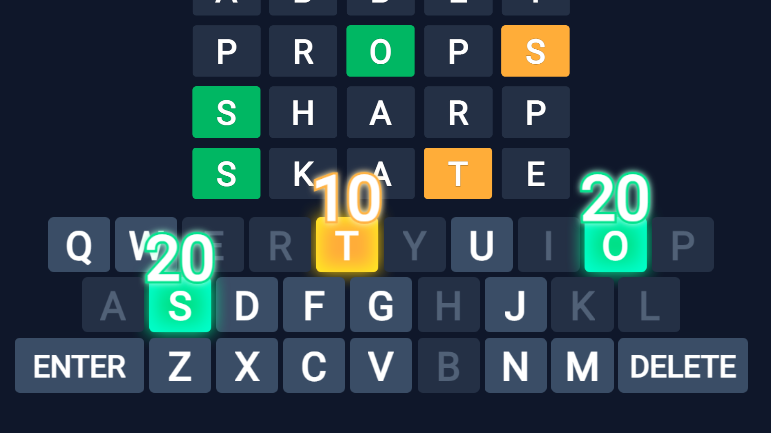
Hard Mode. If a player chooses the hard difficulty of the game, his Final Score will be multiplied by 1.5.
The Maximum possible score: 1500 points for the first Hurdle + 1400 points for the second Hurdle + 1400 points for the third Hurdle + 1400 points for the fourth Hurdle + 1100 points for the final Hurdle + 4000 bonus points = 10800 (Normal mode)
NOTE: in hard mode your score will be multiplied by 1.5 so the highest score in hard mode is 10800 * 1.5 = 16200 points
Using Gems
The Hurdle now allows gems to help you guess the word of the day! Three different helping options can be accessed by using gems.
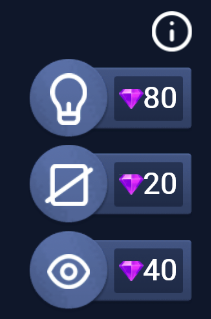
There are three different types of help that you can use:

Clue. The clue will display a clue about the target word. You can guess what it is through a short description.

Remove. Remove will turn three letters of the keyboard gray, improving your chances of guessing the correct ones.

Reveal. Reveal will reveal one of the letters in the word, helping you with the total result.
Archive Puzzles
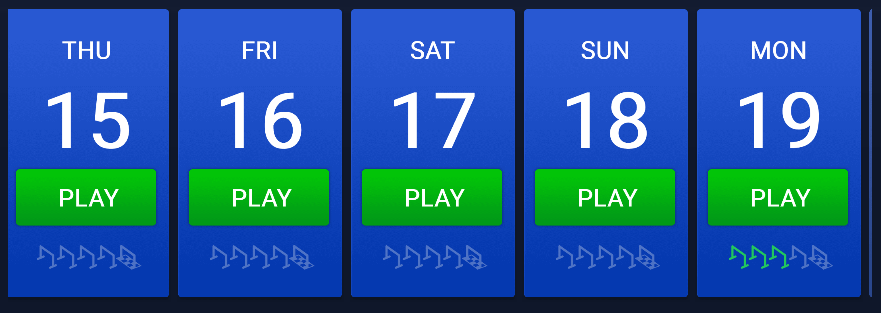
Regular players can access each day's Hurdle game, and if you register a free account with Arkadium, you'll be able to access yesterday's game in case you've missed it.

30-Day Archive. However, Arkadium Plus subscribers can access an exclusive full archive of the past 30 days of Hurdle word puzzles.
Tips for Improving Your Hurdle Results
1. Choose a balanced starting word
A strong opening word should contain five different letters and test a useful combination of common vowels and consonants. Words such as CRANE, SLATE, TRACE, RAISE, or STARE usually provide more balanced information than vowel-heavy words such as ADIEU or AUDIO.
Avoid repeated letters in your first guess unless you have a specific reason to test them. At the beginning, checking five different letters normally gives you more information.
2. Use every color as a constraint
After each guess:
Green means the letter is correct and in the correct position.
Yellow means the letter appears in the answer but belongs in another position.
Gray normally means the letter is not present in the answer.
Do not treat the colors as general hints. Use them as firm placement rules when building your next guess.
3. Do not ignore confirmed letters just to test new ones
If the first guess reveals very little, a second word with mostly new letters can be useful. However, once you have several green or yellow letters, your priority should shift from letter discovery to solving the word.
Testing five new letters may provide information, but it also uses one of your limited guesses without testing a realistic solution.
4. Reposition yellow letters carefully
A yellow letter must appear somewhere in the answer, but not in the position where it was tested. When considering your next word, make sure every yellow letter is moved to a new position.
If several positions have already been ruled out, use the remaining possibilities to narrow the word’s structure before guessing.
5. Pay special attention to repeated letters
The secret word may contain the same letter more than once. Examples include words such as KAYAK, MAMMA, or SHEEP.
Duplicate-letter feedback must be interpreted carefully. If your guess contains a letter twice but the answer contains it only once, one copy may be green or yellow while the other appears gray. In that situation, the gray tile does not mean the letter is completely absent—it means the answer does not contain an additional copy.
6. Use word patterns, not just individual letters
Once you know several letters, think about common five-letter structures. Look for:
common beginnings such as ST-, TR-, CR-, CH-, and SH-;
common endings such as -ER, -ED, -LY, and -Y;
likely vowel and consonant positions;
letters that commonly appear together.
Recognizing patterns will usually produce better guesses than rearranging known letters randomly.
7. Avoid unsupported assumptions about singular and plural words
Do not assume that the answer must be singular. A valid solution may be singular, plural, a verb form, or another accepted five-letter word.
Let the color feedback and available letter positions determine the answer. For example, the letters A, C, E, L, S could form several valid words, and the correct arrangement must be established from the positional clues.
8. Use elimination guesses only when they provide enough value
Sometimes two or more possible answers differ by only one unknown letter. If you have enough guesses remaining, you can enter a valid word that tests several of those candidate letters at once.
For example, if the possible answers differ only in their first letters, a carefully chosen test word may eliminate several options in one turn. Do not use this strategy when you have only one or two guesses left unless it can still produce the answer.
9. Solve early to earn a higher score
Hurdle rewards efficient solving. When you complete a regular Hurdle, your score includes points for every unused row. Solving in fewer guesses therefore produces a higher score.
Avoid unnecessary guesses once you have enough information to identify a strong candidate. Correct solutions are important, but solving them earlier improves the result.
10. Remember that the five puzzles are connected
A complete game contains four regular Hurdles followed by a final Hurdle. Answers from the earlier puzzles are carried into the later stages as prefilled guesses.
This means that each early answer contributes information to the overall game. Pay attention to the letters tested by previous answers rather than treating every board as completely unrelated.
11. Analyze the final Hurdle before entering a guess
The final Hurdle begins with the four previous answers already entered, leaving only two additional attempts.
Before typing anything, study all four rows together:
identify every confirmed green letter;
list the yellow letters and their excluded positions;
eliminate all gray letters;
check carefully for possible duplicate letters;
compare the remaining candidates.
Because only two guesses remain, the first final-round guess should be a realistic answer, not a broad exploratory word.
12. Use the on-screen keyboard to track eliminated letters
The keyboard records information from your previous guesses, reducing the need to track every letter separately.
Before submitting a word, check that it does not reuse gray letters unnecessarily and that it respects all known green and yellow information. Pen and paper can still help when several possible arrangements remain, but it is optional.
13. Use assistance tools strategically
Hurdle provides three forms of assistance through Gems:
Clue provides a description of the target word.
Remove turns three incorrect keyboard letters gray.
Reveal uncovers one letter in the answer.
Use assistance when it meaningfully reduces uncertainty. A Clue may be most useful when you recognize the letter pattern but cannot identify the word, while Remove is useful when too many candidate letters remain.
14. Practice with archived puzzles
Regular players can access the current daily puzzle, registered players can access the previous day’s puzzle, and Arkadium Plus subscribers can access the 30-day archive.
Use archived puzzles to practice strong opening words, repeated-letter logic, and final-round analysis. After each game, use the Recap feature to review where a more informative guess could have saved a turn.
15. Try Hard Mode after developing a consistent strategy
Hard Mode multiplies the final score by 1.5, making it valuable for experienced players seeking higher scores.
Before relying on the multiplier, become comfortable interpreting color feedback and solving consistently. A completed Normal Mode game—with its full-game winning bonus—can be more valuable than an unsuccessful Hard Mode attempt.
Using the Bot
If you're having trouble with the Hurdle puzzle, you can always use our bot when stuck on a word.
Our bot is accessible through the "Chat With Us" button in our website, or the question mark chat icon on the lower right of the Support Portal.
When using the bot, first type "I am playing Hurdle" so that the bot has context to your query. Then, you can ask it a question.