This is a guide to our original Mahjongg Solitaire Game. We currently have a sequel to this game with brand new updates and features, called Mahjongg Solitaire II. You can check out the guide for it Here.
Use the list below to navigate specific topics about Mahjongg Solitaire.

General information. Mahjongg Solitaire is a solitaire matching game that uses a set of Mahjong tiles. The 144 tiles are arranged in special layouts with their faces upward. Players can only match pairs of tiles where each tile has at least one side (left or right) free and no other tiles placed on top. Matching tile pairs can be removed by clicking on each tile in the pair.

Goal. The goal of the game is to clear the layout by pairing up all the tiles. Solving a Mahjong Solitaire board puzzle is all about avoiding a situation where there are no matches left. There is always at least one valid solution for the board.
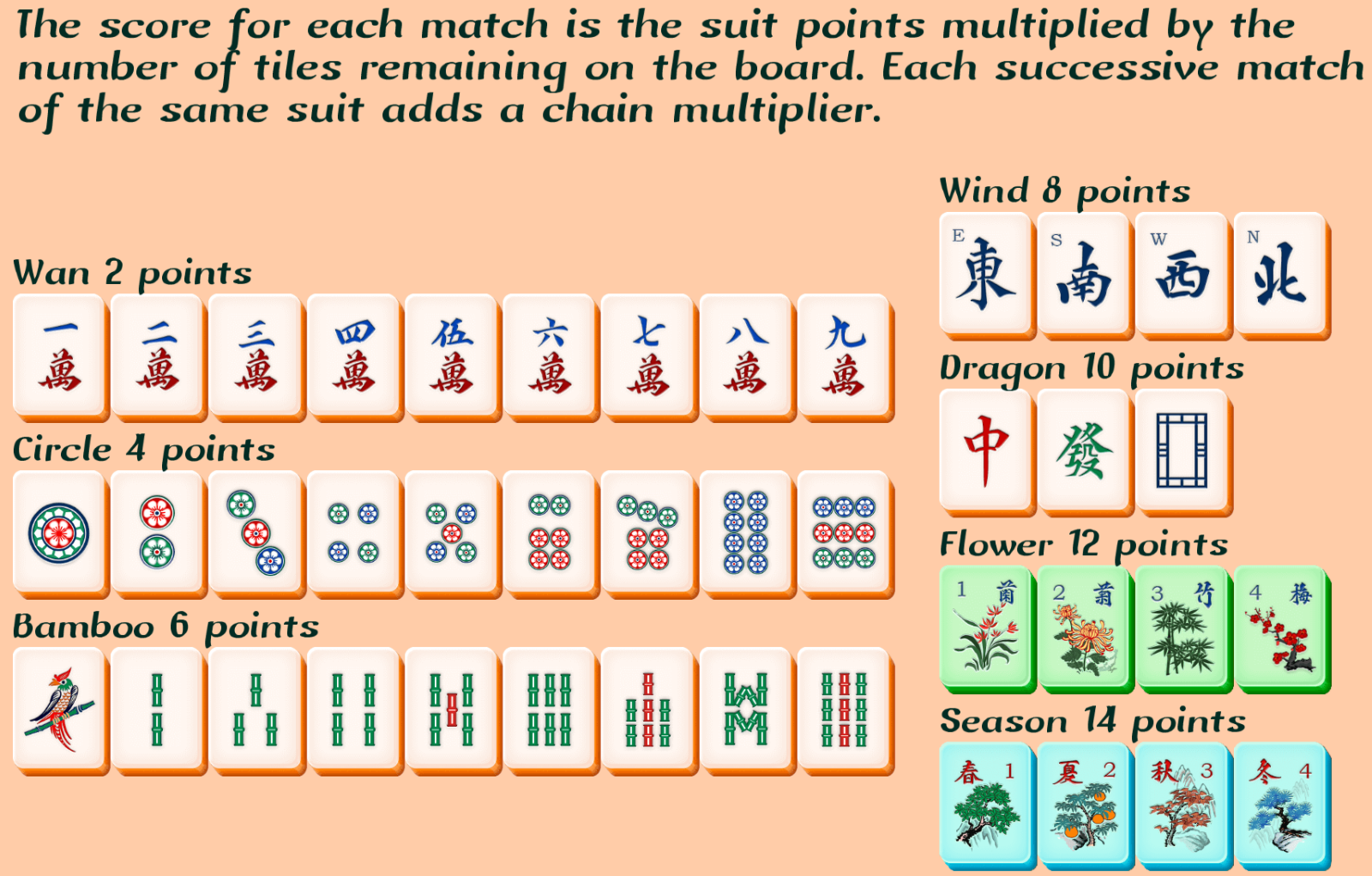
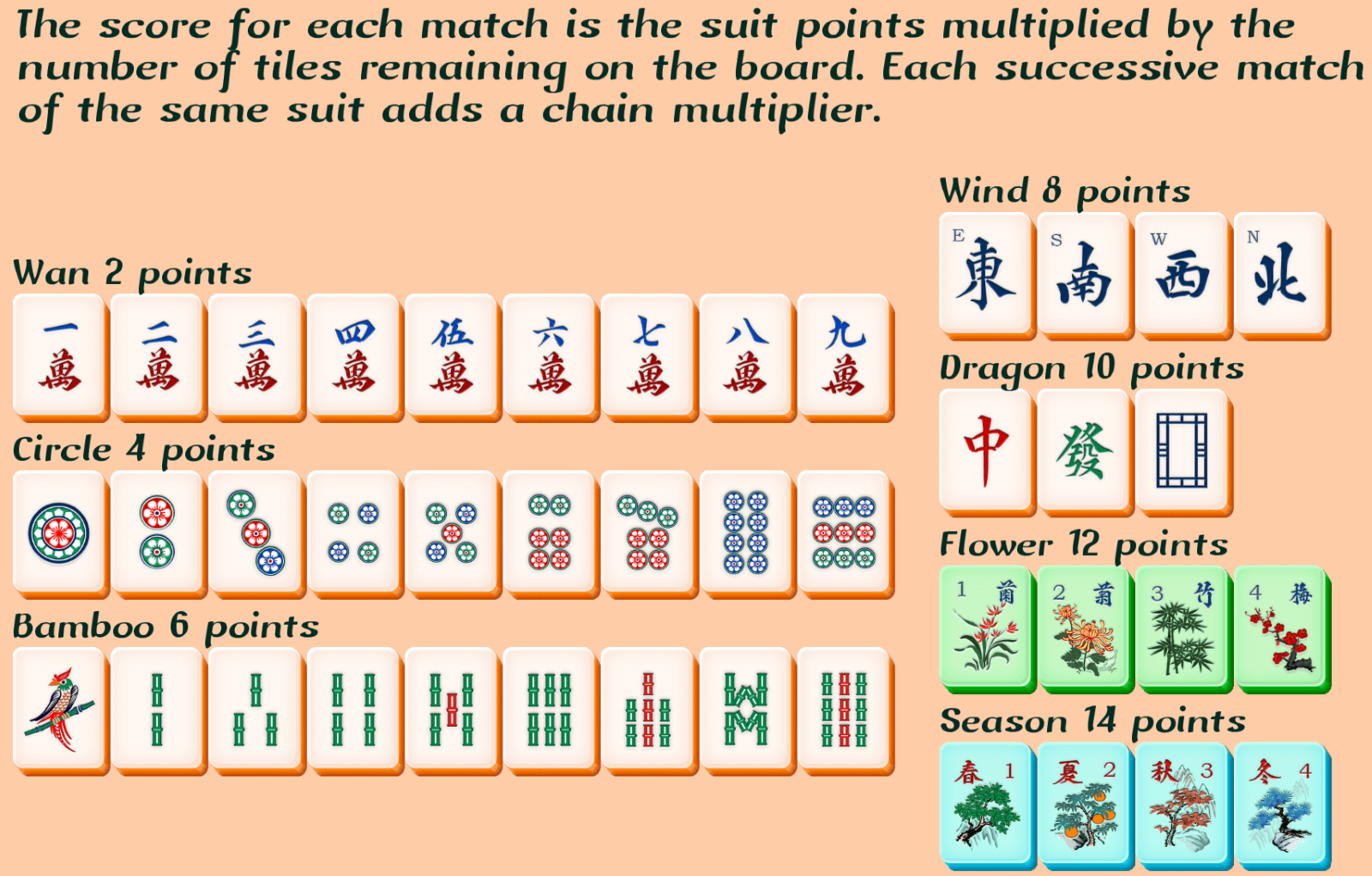
A player can only remove the tiles one pair at a time. There are a total of 72 pairs in a game of Mahjongg Solitaire. Like cards, the tiles have standard suits. These suits are Wans, Circles, Bamboos, Winds, Dragons, Flowers, and Seasons.
Matching of tiles. Exposed pairs of identical tiles are removed from the layout one at a time, gradually exposing lower layers to play.
NOTE: Seasons and Flowers are the only suits you do not need to match exactly. Any Season or Flower combination counts as a pair because there is only one of each tile
Tips
1. Make sure both tiles are free
A tile can be selected only when no other tile is covering it and at least one of its sides—left or right—is open.
Before planning a pair, check both tiles carefully. Two identical tiles cannot be removed if either one is covered from above or blocked on both sides.
2. Choose matches that reveal new tiles
The best match is not always the first available pair you notice. Prefer matches that uncover additional tiles or open the sides of several blocked tiles.
Before removing a pair, look underneath and beside it. A strong move may reveal several new matching possibilities at once.
NOTE: if you have a pair that does not open any way to other tiles, leave it until you need it
As you can see in the example below, removing the top tile opened 5 more matches. That is extremely useful! This made it so you have five extra tiles to use for other matches.

3. Work on both the vertical and horizontal structure
Mahjongg Solitaire layouts must be solved in two directions:
removing upper-level tiles exposes the layers underneath;
removing tiles from the outer edges opens long horizontal rows.
Do not focus exclusively on the top of the layout. A low tile on the far left or right may be just as important as a tile covering the center.
4. Prioritize exposed top tiles and outer edges
Top tiles often block several tiles underneath them, while tiles at the ends of long rows control access to the tiles beside them.
When choosing between otherwise equal matches, favor the pair that removes a top tile, opens an outer edge, or accomplishes both.
5. Keep the number of available matches as high as possible
The game ends if no free matching pairs remain. Use the available-match counter to monitor the health of the board.
A move that creates several new matches is generally safer than one that removes a pair without exposing anything. If the number of available matches keeps falling, reconsider which areas of the layout you are opening.
6. Do not remove harmless pairs too early
If a free pair does not block or reveal any other tiles, it may be useful to leave it available. That pair can serve as a safe move later if other sections of the layout become temporarily difficult.
Prioritize pairs that improve access to the board rather than clearing every obvious match immediately.
7. Choose carefully when three identical tiles are available
When three matching tiles are free, there is more than one possible pairing. Do not automatically select the first two.
Compare the consequences of each combination and match the pair that reveals the most useful tiles. Choosing the wrong two may leave the remaining copy blocked with its only possible partner.
8. Plan around all four copies of a tile
Most standard tiles appear four times in the layout. Try to keep track of which copies are free, which are blocked, and which tiles they are covering.
Avoid removing two easily accessible copies if doing so could leave the remaining two blocking each other. Consider the position of every visible copy before committing to a pair.
9. Handle Flowers and Seasons correctly
Flower and Season tiles follow special matching rules:
any free Flower can be paired with another free Flower;
any free Season can be paired with another free Season;
Flowers and Seasons do not pair with each other.
Because these tiles do not require identical images, they provide flexible matching opportunities. Use that flexibility to remove tiles that open important sections of the layout.
10. Learn to distinguish similar-looking tiles
Some Character, Bamboo, and Circle tiles can look similar when scanning the board quickly. Winds and Dragons can also be confused until their designs become familiar.
Take an extra moment to confirm a pair before selecting it. Learning the tile families will improve both speed and accuracy.
11. Look several moves ahead
Before removing a pair, consider:
which tiles will become free;
whether those newly exposed tiles have available partners;
whether the move opens the left or right side of a row;
whether it reduces or increases the number of available matches;
whether another pairing of the same tile would produce a better result.
A move can be legal without being strategically useful.
12. Build scoring chains without sacrificing the board
Matching the same suit repeatedly increases the Chain Multiplier. If several safe matches are available within one suit, playing them consecutively can improve your score.
However, do not preserve a scoring chain if it forces you to ignore a move needed to open the layout. Completing the board is more important than maintaining a multiplier.
13. Consider tile values when moves are strategically equal
The tile suits have different scoring values. Winds, Dragons, Flowers, and Seasons are worth more than Wans, Circles, and Bamboos.
When two moves provide the same strategic benefit, choosing the higher-value pair may improve your score. Board access should still take priority over the value of an individual match.
14. Use Hint as assistance, not as an instruction
Hints are unlimited and do not reduce your score. Use the Hint button when you cannot locate an available pair.
A hint identifies a legal match, but it may not identify the best strategic match. Before removing the suggested pair, check whether another available pair would expose more tiles or protect the layout more effectively.
15. Balance speed with careful planning
You must clear the layout before the timer expires, but matching tiles too quickly can create an unsolvable position.
Scan the board efficiently, but pause briefly when several matching options are available. A few seconds spent comparing moves can prevent a much larger problem later in the game.
With practice, you will become faster at recognizing free tiles, remembering matching positions, and identifying the moves that open the greatest number of possibilities.
Settings
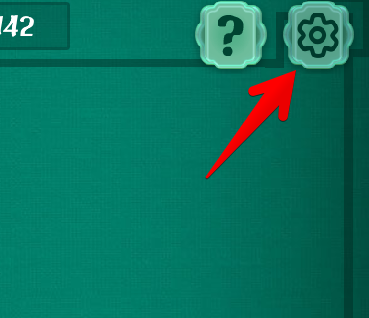
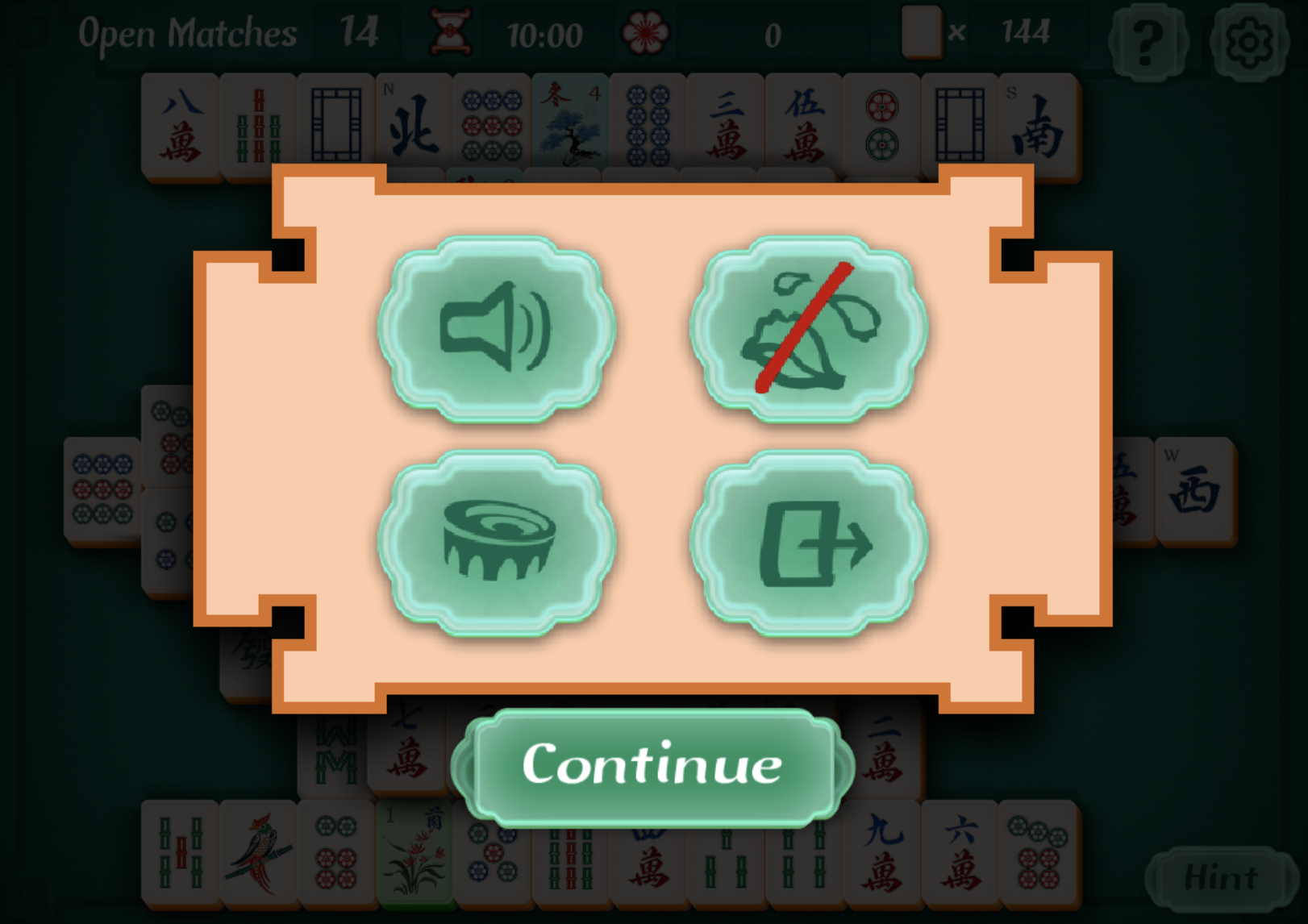
By pressing the gear icon on the top right, you can use different settings in the game.
The Sound Icon allows you to turn on and off the sound in the game.
The Arena Icon allows you to know more about the creators of the game.
The Door Icon allows you to exit the game and post your score.

Disable the falling petals. You can disable or enable the game's falling petals effect in the menu. Should the falling petals not be to your liking, or should they be too distracting, we now offer an option in the menu to turn them on or off. Simply select click on the petals icon on the top right of the menu, as pictured here.
All these tips may look intimidating the first time you play Mahjong solitaire, but don’t worry! This game is easy to learn but challenging to master. You will learn everything eventually, leading to fewer unsolvable situations after each successful game.
My tiles are blank, what happened?
You might encounter a situation in which the Mahjongg Solitaire tiles appear to be blank. they will appear to you like in the screenshot below:

This occurs when you click on something outside of the range of the game, or when another window, application or program is selected instead of the game. Selecting an outside window or application will pause the game. Because the game is paused, it would be unfair to show the tiles, as this would give an advantage to players to pick the correct tiles by pausing the game, bypassing the timer rules. So for this reason, pausing the game by selecting a separate window, program or application, will also show the tiles as blank.
If you're having issues with the tiles appearing as blank dispite not having any program on top, please check on whether any of your programs or extensions may be causing this. If you're unable to find anything, be sure to contact support for help.
Scoring
General Formula:
Final Score = Score for each suit * 2 * Chain Multiplier * Remaining Tiles Multiplier + Bonus Score.
NOTE: using the hint button doesn't affect the scoreChain Multiplier = 1. Increases when you match the same suit in a row.
Remaining Tiles Multiplier = Number of remaining tiles on the board
Bonus Score (percentages) = Number of Pairs Matched * 2 * 144.
Each suite is worth a different value:
Suite | Points per tile | Points per match |
WAN | 1 | 2 |
CIRCLE | 2 | 4 |
BAMBOO | 3 | 6 |
WIND | 4 | 8 |
DRAGON | 5 | 10 |
FLOWER | 6 | 12 |
SEASON | 7 | 14 |